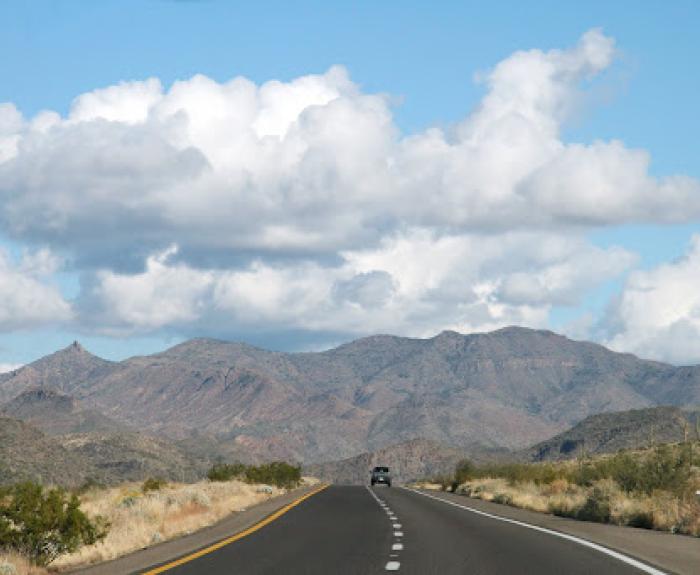
Freeway in the desert

ADOT Blog

Latest blog articles

It’s a reflex for most of us to pick up our phones when we hear the familiar dinging sound that lets us know we have a new text to read. You might think it’s not that serious to look down at your phone and respond to a text while you’re...
In this episode of On the Road With ADOT, Jason Stephens of ADOT's Community Relations team has an update on the many projects resuming and starting now that warmer weather has returned to Northern Arizona.
We're highlighting an ASU News article features a partnership that’s helping ADOT learn how to optimize water use in freeway landscaping. The ADOT Urban Freeway Landscape Water Use Efficiency Project nvolves graduate students who are part of ASU’s Arizona Water Innovation Initiative

Popular blog articles

We asked and you answered! Back in December when we told you about the Quiet Pavement Pilot Program, we launched a survey asking for your thoughts on freeway surface conditions in Maricopa County.
Nothing seems to slow a commute down like having to stop at one red light after another. That’s why ADOT is working to synchronize some of its signals – a move that can help traffic flow a little more smoothly while reducing the type of stop-and-go traffic that can lead to congestion.
There's a lot of useful information to be obtained from our roadways and loops help ADOT collect some of that data.
Last week we received a blog comment requesting an update on the I-17 bridges that span over Pinewood Boulevard in Munds Park. We thought it was a great suggestion and figured a blog post was in order!
Yesterday we told you about ADOT’s Pavement Materials Testing group and how it is responsible for testing aggregate and creating asphalt friction course mix designs.
Placing asphalt friction course on a newly constructed road is sort of like icing a cake (stay with us here).
Remember this awesome time-lapse video showing the construction of a temporary bypass at Greenway Road and the Loop 303? Well, today we’ve got an even more in-depth look at how crews built the new intersection – complete with temporary barriers, fences and traffic signals – in just about 43 hours! (Take a look at the photos below for an amazing before and after aerial glimpse of the new bypass!)
When ADOT builds a freeway, there is an essential step that surprisingly requires absolutely no construction or even heavy lifting. We’re talking about partnering – the ADOT and construction industry process that allows everyone on the project to get together, set goals and talk about the work ahead.
You've probably never gotten a good look at the Passive Acoustic Devices (PAD) out on the freeways … they're easy to miss. PADs are small objects that sit near the top of utility poles and are barely visible to drivers below, but they collect a lot of useful data.
If you’ve been following our Building a Freeway series, you should be pretty familiar by now with much of the work that’s happening out on the Loop 303.