Freeway in the desert

ADOT Blog

Latest blog articles

In this 10-minute episode of On the Road With ADOT, Public Information Officer Garin Groff discusses Southern Arizona improvements that are starting, continuing and finishing in 2026, including major upgrades for the Tucson area.
The 1934 US 60 Salt River Canyon Bridge still exists - and pedestrians can still walk on it.
The Maricopa Association of Governments' Chief Transportation Officer returns in this week's episode to discuss how Proposition 400 has shaped the region's success through projects such as the recently completed I-10 Broadway Curve improvement, the Loop 202 (South Mountain Freeway), Loop 303 (Estrella Freeway) and State Route 24 (Gateway Freeway).

Popular blog articles

Last week we received a blog comment requesting an update on the I-17 bridges that span over Pinewood Boulevard in Munds Park. We thought it was a great suggestion and figured a blog post was in order!
Yesterday we told you about ADOT’s Pavement Materials Testing group and how it is responsible for testing aggregate and creating asphalt friction course mix designs.
Placing asphalt friction course on a newly constructed road is sort of like icing a cake (stay with us here).
Remember this awesome time-lapse video showing the construction of a temporary bypass at Greenway Road and the Loop 303? Well, today we’ve got an even more in-depth look at how crews built the new intersection – complete with temporary barriers, fences and traffic signals – in just about 43 hours! (Take a look at the photos below for an amazing before and after aerial glimpse of the new bypass!)
When ADOT builds a freeway, there is an essential step that surprisingly requires absolutely no construction or even heavy lifting. We’re talking about partnering – the ADOT and construction industry process that allows everyone on the project to get together, set goals and talk about the work ahead.
You've probably never gotten a good look at the Passive Acoustic Devices (PAD) out on the freeways … they're easy to miss. PADs are small objects that sit near the top of utility poles and are barely visible to drivers below, but they collect a lot of useful data.
If you’ve been following our Building a Freeway series, you should be pretty familiar by now with much of the work that’s happening out on the Loop 303.
Maybe you've noticed some of the cameras that are perched high above the roadways ... These are Closed Circuit Television (CCTV) cameras and are used by ADOT's Traffic Operations Center (TOC) to constantly monitor traffic conditions throughout the state.
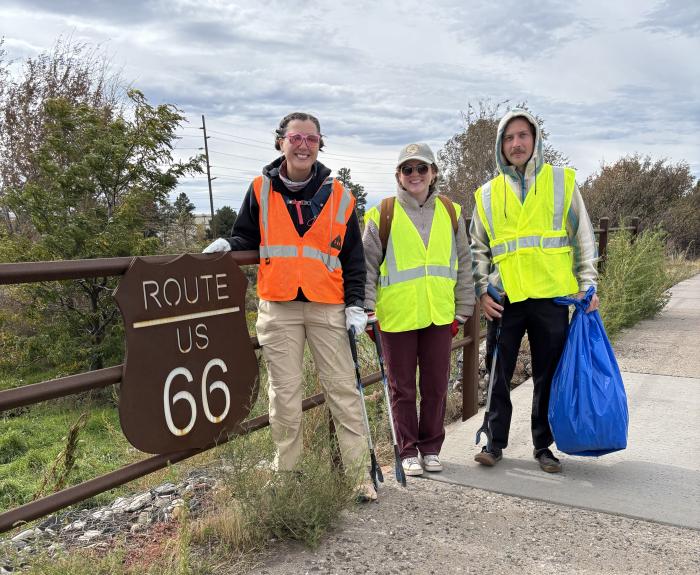
We’re thankful for the approximately 1,570 volunteer groups who currently adopt an Arizona highway. It’s hard to believe, but roughly 335 of the groups have been volunteering for more than 10 years and of those, 50 have been with Adopt a Highway for more than 20 years!
Short of a time machine, travel demand models might just be the next best thing for taking a glimpse at the future of our transportation system. So, what is a travel demand model?